Wednesday, January 19, 2011

#35: Little Children


A chance meeting between two young parents turns into a passionate extra marital affair. A sexual offender tries hard to let go off his habits and finds himself helpless in doing so. An overly self-conscientous ex-cop thinks he has every right in the world to bully the offender's Mom while the Mom hopes against hope that someday her son would be able to lead the life of a good boy. These interlinked threads form the complex yarn that the film Little Children is.

It is complex not because the stories are difficult to follow but because they are pregnant with repressed emotions. Kate Winslet plays Sarah, a woman who finds herself drawn to Brad(Patrick Wilson)and soon transforms an innocent meeting with him into a relationship so serious they don't think twice before wishing to run away from their existing spouses. This story angle is the most engrossing of the lot that confront you in the movie that has what I would call a poetic pace. With some soothing photography, Antonio Cavalche does give viewer the leeway to sink into each of those stories but fails to grip an unwavering attention due to a slightly heavy storyline. I haven't read the book the movie is based on but I suspect in trying to give each of those stories it's due, something doesn't seem to gel in together.

Kate Winslet, however, is one reason why you should watch the movie-as she traverses the worlds of being the neglected wife, the reluctant mother and a passionate lover with consummate ease in a span of little over 2 hours. In one scene of jubilation she will sweep you off her feet with the nonchalant innocence of it and in another she'll break you heart with a rude indifference towards her kid. Jennifer Connolly doesn't really have much to do as Brad's wife and is nearly wasted while Patrick Wilson as Brad does enough to connect with a viewer with his emotions.

Little Children is at it's heart a movie about intense relationships - whether it's those between a mother and a son, a husband and wife or those people who want to re-establish their rapport with a society that they inhabit. Acceptance is salvation for these characters and they try within their means to get there. Such a journey for a viewer doesn't necessarily make for a fulfilling watch but surely an acceptable watch.

Rating: 6.3/10

Tuesday, January 18, 2011

#34: Some Like it Hot


It's probably not going to find too many takers but I have to say that a movie like Some Like it Hot is the kind that doesn't age well. Billy Wilder, one of the most accomplished of all directors, made this movie in 1959 at the peak of his career right after he finished the fantastic court drama Witness for the Prosecution.

In an extra on the Stalag 17 DVD, someone once mentioned about how Billy Wilder has made the most definitive movie in every genre that there is in cinema. In that sense Some Like it Hot was Billy's definitive movie in the genre of screwball comedy. Why I said that still is a movie that doesn't age well, is because by the time I caught it, I had seen the all-too-familiar gag of men dressed as women and the jokes that it could possibly evoke about hairly legs and unshapely boobs in far too many movies like Mrs. Doubtfire.

That said, it is perfectly understandable why a movie with a cast of Marilyn Monroe, Jack Lemmon and Tony Curtis would be lapped up by audiences worldwide. For one, Jack Lemmon and Tony Curtis are irreprisible as Joe and Jerry- two musicians out of job, who witness a mob killing and have to run away from Chicago. Their best chance is to dress up as women and join an all-girl band headed to Florida and that's where they meet Sugar (Marilyn Monroe). The movie from there on is their story of how they both fall for Sugar and how they manage to dodge the mobsters who are on their chase. It does have a few funny moments but nothing that could qualify as a laugh-out-loud one. The special thing about it has to be the chemistry between Joe and Jerry. In all the scenes that they are in together, they do a wonderful job, particularly Jack Lemmon, who plays a slightly more elevated role of what is traditionally called a 'sidekick' to the main character of Tony Curtis.

I'll have to stick my neck out in saying that Some Like it Hot wouldn't be a hot favorite of mine when I list down my favorite all-time funny movies. It is funny alright but at the time I saw it, it had outlived it's gags. It still is a must-watch to appreciate the range and versatility of one man and that is Billy Wilder. One has to be a genius to make movies like Ace in the Hole, Stalag 17, Sunset Boulevard and follow them up with a Some Like it Hot.

Rating: 6.9/10

Monday, January 17, 2011

#33: Failure to Launch


Failure to Launch is a story of a middle-aged man, Tripp(Mathew McConaughey) who stays with his parents and thinks it is perfectly normal to do so. His friends also don't mind this aberration and that makes it easier for Tripp to get along with his lifestyle. So he befriends women, falls in love and gets dumped that easily because no girl seems to like the fact that he feeds off his parents.

That until, his parents hire Paula (Sarah Jessica Parker), an interventionist who specialises in making men fall for her and then convince these men to move out of their homes. If the phrase 'bizzare script' is coming to your mind, as you're reading this, then well, you have company. The plot is hugely predictable and clumsy. The performances barring Mathew McConaughey's are amateur and the supporting cast of stars such as Zooey Deschanel and Bradley Cooper are wasted in senseless roles.

Director Tom Dey doesn't manage to excite you through any of the silly gags he conjures. There are scenes of a chipmunk, a dolphin and a lizard biting Tripp that are supposed to evoke laughs but these are nothing more than disastrous attempts at comedy. The only thing that works for the movie is McConaughey's portrayal of the lazy and easy going Tripp. He essays it with charm and in a couple of scenes laced with emotion comes out unscathed. There is little to add about any other artist in the movie.

As far as chick flicks go, Failure to Launch is as mediocre as they come. As far as movies go, it is a failure to film sensibly indeed!

Rating: 4.1/10

Saturday, January 15, 2011

#32: Turning 30


Alankrita Shrivastava, the director of Turning 30 is a Prakash Jha protege having assisted him in movies like Gangaajal and Apaharan. What she brings to table though in the form of the chick flick Turning 30 is essentially a style that is refreshing and very different from that of her mentor's who banks more on gritty style of film-making.

Wearing the dual hat of the writer and the director, Alankrita uses the advertising fraternity and the city of Bombay to highlight the travails of Naina(Gul Panag) who's dumped on the eve of her 30th birthday by her longtime boyfriend, Rishabh (Sid Makkar). Things turn worse when professionally she ends up on the backfoot due to an advertising campaign that goes awry. The movie captures how Naina goes through this difficult phase in her life when people around her lose no time reminding her that turning 30 and being single is a shame. The other key character in the movie is Purab Kohli who is effortlessly charming in his turn as Jai- Naina's college sweetheart.

Gul Panag's renders an endearing performance as Naina as you easily end up sympathising with her mid-life crisis. The movie has a few heartwarming moments especially the ones between Naina and Jai that are replete with some neat insights about adult relationships. The supporting cast that includes two bubbly friends of Naina do justice to their roles and always seem to make you believe that these are the very kinds of friends you and I have in our daily lives. The fact that the characters converse in English gives it an overall slice-of-life feel that should work for metropolitan audiences.

The film however at times tries to do a bit too much with certain needless angles - an example is that of a lesbian couple thrown in bang in the middle of the movie for no good reason. Such temptation on the part of the director to pack more elements than just focusing on the main storyline tends to take away the sheen off the movie's central plot. Naina's 'jobless and menless' line is repeated so many times in the first half almost drumming it into the audience's head when everyone actually gets the plot within the first 20 minutes. While there's some merit in some of the potshots taken at the advertising fraternity, there is also a lot of liberty taken in exaggerating certain cliches. Also, the soundtrack is as mediocre as they come.

By itself, Turning 30 is what will count as an ok movie. For a debut writer-director though, this is a good effort and a commendable shot at making a new-age urban film. The biggest advantage of the movie is the fact that it's a simple, matter of factly relateable watch. It's surely worth it if you're actually a single woman turning 30 for it comes close in capturing the essence of the subject. The problem though is that it doesn't have anything that would make the experience of watching it memorable.

Rating: 5.9/10

Friday, January 14, 2011

#31: The Boston Strangler


The Boston Strangler doesn't appear in the movie until the first 61 minutes and yet when one finishes this 2 hour classic your mind is only filled with the stirring performance of the man who plays The Boston Strangler - Tony Curtis.

In what must count as one of the finest acts in the history of motion pictures Tony Curtis essays the role with so much perfection, it's hard to not be affected by it. That he manages to do it in the company of another doyen of acting - Henry Fonda embellishes it. Seldom must've Henry Fonda gone into a movie and come out second best as a performer. And that's just one aspect of the movie that is brilliant. Now let's take the story. A story has to be effective when the promo teaser of the movie says - 'Albert DeSalvo loved his wife, spoilt his children and brutally murdered 13 innocent and helpless women'. And the one question that you're struck with many a time during the movie is: "Is HE really the strangler? He can't be. Something must be wrong." When a story engages you to such an extent, it's obviously pretty darn good. It's also a pretty good example of how fact could be stranger than fiction- after all this is a true story.

Now if you've a story as brilliant, how easy it really should be to put it in motion when you also have a cast of Tony Curtis and Henry Fonda in the lead. And this is where director Richard Fleischer breaks all convention and invents a new visual technique of storytelling where at critical points of the movie the screen is divided into 6-7 small parts to depict the on-screen action. Especially in the context of the story where a killer is on the loose, the effect is so devastatingly claustrophobic you could smell the tension on the screen.

For a movie with 13 murders, the movie does exceptionally well in not going above board in displaying violence. The restraint is not just evident in this aspect but also in that of the entire cast. Each one is holding something back. Many a time, you would think Henry Fonda as the investigating officer is about to lose his cool and yet at a time when his team ends up making a mockery of itself, all he says is, "We seem to have made a beautiful landing at the wrong airport..."

Tony Curtis was too much of a dark horse to get this role, the studio executives were scared to touch this movie wondering if it was too violent and once when Curtis got himself hospitalized after an action sequence during a movie,there were even reports that he was being thrown out of the movie. The movie had so many things going against itself, that in course of time The Boston Strangler is irrefutable proof that if a story is good and you have men of conviction willing to go the distance with it-Edward Zanuck, the producer in this case, the movie will stand the test of time. And in the case of a movie like this, it will stand very very tall.

Rating: 7.75/10

Thursday, January 13, 2011

#30: Game 6


Game 6 is a movie made in 2005 about Nicky Rogen (Michael Keaton), a playwright whose big opening night co-incides with the final of World Series between the Mets and Red Sox. Since he is also a die-heard Red Sox fan, he let's go off the play's opening and ends up watching the game with a cabbie and her grandson.

From the time the movie opens till the time he finishes watching the game, there are also other incidents that keep happening to him on this eventful day. These include being coaxed into murdering a harsh drama critic Steven Schwimmer ( Robert Downey Jr.), admitting to his wife about his extra marital affair and seeing his lead actor forget his dialogues in the play's last minute rehearsals. If you're a World Series or an NBA fan, you would know why Game 6 in a final is really important. Director Michael Hoffman uses this momentous occasion in a fan's life as the fulcrum for this story written by Don DeLillo. Michael Keaton is that fan on that kind of a night who will give up anything to see Red Sox win in spite of all the misgivings he has about the opening night of his play.

The other key character in the plot is Downey Jr. whose character of a drama critic possesses the ability to demolish careers with his acerbic writing. As a viewer, you don't know whether Steven is going to thrash the play or not but since Keaton has already heard quite a few complain about Steven's writing, he decides to kill Steven. The best part about the movie though is the passion for baseball that Keaton's character reflects. As a fan, you not only can identify with it but also empathize and admire it. The movie, however. doesn't have any melting point or any peak of a dramatic nature that affects you. It's what we liken in cricket to a par score.

In a nutshell, the movie's plain in it's treatment but not unimaginative. It's a flat story but not without interesting characters. But maybe that's also because Game 6 is just a movie and not the actual Game 6 in a playoff series. And right after that, as ironic as this might sound, if you're a baseball fan, you're sure to enjoy it

Rating: 5.7/10

Wednesday, January 12, 2011

#29: Killing Me Softly


If you see director Chen Kaige's Farewell My Concubine, you would know exactly why he is such an accomplished director. And if you see Killing Me Softly, you should be forgiven for wondering if that's also made by the same director. Killing Me Softly is movie about a reticent mountaineer's chance encounter with an ad executive and their subsequent passionate liaison that leads to marriage. Joseph Fiennes and Heather Graham play the lead actors as in these roles and try to resuscitate what essentially is a drag of a story.

Alice (Heather Graham) leaves her live-in boyfriend for Adam( Joseph Fiennes) and that scene unintentionally becomes a funny scene because of the boyfriend Jake's (Jason Hughes) antics once he's told he's being dumped. It should've been a delicate scene in most movies but the mediocrity of this scene sets the tone for the rest of the movie. If one chance encounter can lead to such unbridled passion, there should've been some of that oft-used word in movies - chemistry- between Adam and Alice but that is replaced with some plain-vanilla love making scenes that do not have a semblance of the sort of spark seen in movies like Unfaithful

Alice and Adam end up marrying each other and no sooner than on the wedding night itself, Alice begins to feel the strain of the mysteriousness that engulfs Adam's character. Later, she is informed through random sources that Adam has been a rapist or has been married before- things that unsettle Alice to such an extent that one night she just runs away from home in her night gown. The movie also has a bizarre twist which leads to one of the characters being accused for murder. How they come across the victim's body in the middle of nowhere is laughable and adds to mediocrity on display.

Between being a romantic story, a murder mystery and an erotic tale between two individuals, the movie ends up being nowhere. Heather is pretty as a picture and that's probably the best thing about the movie. Joseph as the passionate husband with his stone faced expression throughout the movie and little else has done far better turns in some of the other movies ( Shakespeare in Love, Enemy at the Gates) he's been in. The movie's tagline is How can you escape, what you can't resist. In the case of Killing Me Softly, you can resist it and escape the misfortune by simply not bothering to watch it for it is an insipid story with uninspiring performances.

Rating: 3.8/10

Tuesday, January 11, 2011

#28: The Wrestler


The Wrestler is a moving story set in 2009 about Randy Robinson(Mickey Rourke), a hugely popular professional wrestler from the mid-80s. The film's opening credits are a piece of beauty as they explain in a few minutes the might of Randy Robinson in the '80s to the audience through an on-screen collage of newspaper cuttings and voice overs of wrestling commentary from those days. Cut to the present time, 20 years later and we see Randy sitting alone in a hall with both his hands strapped and another minute later when he doesn't move we realize this is a desolate man at the end of a sagging career. So much is conveyed in so little time that the film grips you with this intense beginning.

As the character is further developed, we are introduced to Randy's only friend Cassidy(Marisa Tomei), who works in a strip joint and his estranged daughter Stephanie(Evan Rachel Wood) who doesn't think twice about calling her Dad an asshole. Make no mistake, this is a story about 'The Wrestler' and in director Darren Aronofsky's able hands, Mickey Rourke is the centerpiece of virtually every scene there is in the movie. He makes you sympathise, cheer and admire Randy for the nice buddy that he is to his friends, the father that he wants to be for his daughter and the not-just-another-customer he wants to be for Cassidy.

Mickey Rourke, whom we better knew as the guy from the erotic saga of 9 1/2 Weeks is an artist at work in this movie. While his professional boxing career would've helped in the preparation for this role,(he even wrote some scenes for the movie to make it more real) nothing takes away the endearing mould that Mickey carves out for Randy's character. He plays with kids, shops for clothes for his daughter and even dances to GNR in a pub that takes the viewers closer to him. Mickey went through training with professional wrestlers for eight weeks while prepping for this role and it goes a long way in making him take to the role of Randy like a duck to water. Marisa Tomei, hot as the hottest piece of burning coal there can be, plays the support that Randy so badly needs in his life. The only weak link in the movie probably is the transformation that her character goes through in the movie- that particular segment makes you feel it could've been wrought with a bit more tension as it happens too easily.

It's amazing sometimes how movies can mirror reality. The Wrestler is the movie that is said to have resurrected Mickey's Rourke's sagging career. In a befitting context, all that the character of Randy wants in the movie, is another shot at glory that he has had in the past. Writer Robert Siegel and Darren Aronofsky may or may not have seen the parallel but the movie does benefit because of this similarity. And ironically though this is a movie about the world of professional wrestling that's all about fake fights(you'll realize there's more to them though once you see this) and back-stabbing, it's also a film with a lot of heart and a lot of warmth- something that will stay with you long after you've seen the movie.

Rating: 7.2/10

Sunday, January 09, 2011

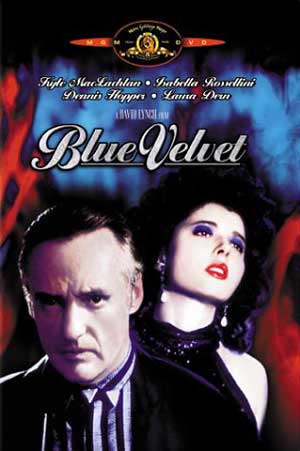
#27: Blue Velvet


Blue Velvet, a film directed by David Lynch in 1986 much before his more popular Mulholland Drive( 1991) is the story of a young man's curious tendencies towards his mysterious neighbor in the sleepy town of Lumberton. The young man is Jeffrey ( Kyle Machlachlan) and the neighbor is a woman named Dorothy Vallens (Isabelle Rosellini) who is under the radar of the local police as a murder suspect. A casual conversation between Jeffrey and his friend Sandy (Laura Dern) piques the former's curiosity enough to sneak into Dorothy's apartment.

It is this inquest into the house that gives the movie it's momentum after a poetic start replete with some wonderful photography and the extremely likeable title track- "She wore Blue Velvet...". In what is a brilliant stroke by writer-director David Lynch, Jeffrey after landing himself in Dorothy's apartment suddenly finds himself possessing information that could become pretty handy for the local police in solving some of the crimes that have been going around in Lumberton. This information goes back to a person named Frank, played by Dennis Hopper, who not only physically abuses Dorothy at will but also has kidnapped her son and husband in return for sexual favors from her. Dennis Hopper is the very incarnation of evil in his role and delivers a staggering performance as the menacing Frank- a portrayal so riveting that with him on screen, you won't as much twitch your nose to breathe.

While Blue Velvet is a movie about crime, it also has a couple of morally complex storylines about how both Sandy, in spite of having a boyfriend and Dorothy end up liking the simpleton that Jeffrey is. The social triangle of affection between Sandy, Dorothy and Jeffrey becomes a point of conflict that is resolved only towards the end. At one point, Jeffrey is so taken in by his adventurous spirit that in his attempt to rescue Dorothy from Frank he finds himself embroiled in a group of bad men, led by Frank who threaten him that "he should count himself as f***ing lucky to be alive...". However, as in a typical film-noir movie, almost all characters have their dark shades that make it interestingly engaging for the viewers to judge them during the movie. The haunting background score goes a long way in coloring the movie with a lot of character and music is used as a theme that is central to both the characters of Frank and Dorothy.

I saw Blue Velvet in 2011, that's 15 years since it first released when it even got nominated for the Oscars.In the meantime, I had seen a few movies that explore similar ideas of a meek character in trouble pitted against the might of another character. Movies like Night of the Hunter come to mind. I wouldn't say such movies have necessarily been better than Blue Velvet but because they had similar overtones, I am inclined to think that Blue Velvet wasn't really a special one. It had the right ingredients for a compelling watch but unfortunately it just fell short. Not so much as the movie that is at fault but the fact that it just didn't age well enough to be as breathtaking to me now in 2011. It is still something I would seriously recommend if you've never seen a David Lynch movie for it is his lucid style - sometimes which shocks you and sometimes which pleases you but something that at all times effortlessly shines through the movie and makes it more than worth a watch.

Rating: 6.9/10

Saturday, January 08, 2011

#26: No One Killed Jessica


It's a challenging task to make a movie on real-life incidents. Particularly so, when such a subject has been under public glare. The challenge lies in the fact that in the minds of the audience, the climax is predestined before they even as much check the seat numbers on their tickets. Hence in such stories, the director is left with the monumental task of making the journey to that climax exciting because at critical points in the movie the audience can already predict the outcome. As opposed to fictional stories where the writer has the leverage to make both the end and the means to that end engaging enough for the audience. In India, sadly enough we do not make enough of these true stories.

No One Killed Jessica is hence a courageous attempt by writer-director Rajkumar Gupta to pick up a subject that made front page headlines for over ten years in our country and package it in a mainstream Bollywood movie. The source material of the first half of No One KIlled Jessica is the sequence of events that led to the murder of model Jessica Lall in a Delhi night club and the subsequent trial in a special court that sees accused Manish Bharadwaj go scot free in spite of witnesses. The second half is the story of how a TV news reporter rakes up the case in media putting a question mark on the verdict. Gupta manages to convey the story by broadly staying true to the real-life incidents and characters. His leading ladies particularly Vidya Balan turns in a superb performance as the victim's sister fighting for justice against a system that is buying out witnesses. Whether it's her stone dead expression when Jessica's pulse stops or the glint of hope in her eye as one of the prime witnesseses enters the court, it is her that the audience empathises with most. Rani Mukherjee, as the aggressive reporter Meera brings in a lot of spunk to the role, at times even going a tad overboard.

The supporting cast of prime witness Vikram Jaisingh, played by Neil Bhoopalam and the investigating Inspector played by Rajesh Sharma bring sincerity to their roles, especially the latter, who ironically in one line in the movie surmises corruption with a stark streak of honesty. Rajkumar Gupta's attention to detail in several facets of the movie is commendable with the old but familiar Windows 98 wallpaper adorning an editor's desktop taking the cake in a movie that begins in the year 1999. Amit Trivedi's music stitches the movie well, at all times, cohesively with it's screenplay.

Where the movie doesn't work is the final stages where as a viewer you're left a bit stranded as it doesn't reach the crescendo as a movie with such talent really should've. The first half begins with a bang but tends to drag on a bit. Rani Mukherjee's catharsis from a non-believer in the case to a believer is a sub-plot that could've been entirely avoided. No One Killed Jessica isn't the gripping movie that it could've been. It also isn't an over-the-top fare that would leave you cringing in your seats. It's almost a fine balance between the two without leaning towards either side. It deserves a watch for some sincere performances, a neat score and an earnest effort by the director who brings in a lot of heart in dealing with the kind of subject most directors wouldn't touch in a lifetime.

Rating: 6.5/10

#25: Four Rooms


It is a minor milestone of 25 movies today so I thought why not pick a favorite director movie. While that narrowed the choice to a few, I didn't take much time narrowing down to Quentin Tarantino because I had bought Four Rooms some time back and was yet to see it.

Four Rooms is a collection of four segments of stories that take place in an hotel. The segments are written and directed by Allison Anders, Alexandre Rockwell, Robert Rodriguez and QT. The stories have a common link and that's Ted the Bellboy played by Tim Roth who's summoned by guests in each of these four rooms at different times for certain errands. As often in movies that have a collection of stories, one ends up comparing the stories to each other to see which one really stood out. Four Rooms makes this choice simple for the viewer because the movie begins with the worst story and ends with the best. And in this, credit particularly needs to be reserved for old-time partners-in-movies Robert Rodriguez and Tarantino-who wrote and directed their segments titled The Misbehavers and The Man from Hollywood respectively.

Both these stories last for not more than 20-25 minutes each, begin with interesting premises, build up an interesting plot point and have an ending that will surely excite you. QT's story in particular is layered with multiple references to Hollywood, have the trademark long dialogues and signature camera-on-rotate shots that one is so used to as a fan but never, not for a single minute bored with. QT excels as director Chester Rush from Hollywood in this segment along with Bruce Willis who has a cameo. It's interesting to note that Bruce's name doesn't appear in the credits because he did his part for free and the Screen Actors Guild agreed not to sue him if his name didn't appear in credits (from the friendly trivia section of Imdb.com). Robert Rodriguez does well with a pair of kids in his stories and Antonio Banderas playing the role of a Mexican husband who takes his duties as a father of the kids and a husband really seriously.

Since Tim Roth is the one binding factor across all the segments, you might not want to miss his performance which is a complete contrast from some of the other characters he's played in Quentin Tarantino movies. The first two stories are mediocre compared to the last two. Though they try to be a bit whacky in their treatment, they end up being a bit flimsy. It's not difficult to see why Robert Rodriguez and Tarantino have better filmographies than Allison Anders and Alexandre Rockwell - it's almost like the difference between seasoned players and the rookies in a sporting season. Having said that, Four Rooms won't disappoint you. It's the kind of fare that might not be worth a second viewing but it's surely worth a first.

Rating: 6.2/10

Thursday, January 06, 2011

#24: Zelig


It's a common Woody Allen criticism that most of his storylines border on themes of failed and illicit relationships or largely often portray facets of love and death- themes that Woody has acknowledged as being really close to him. While it a valid point, the prolific writer-director who has made a movie every single year since 1969, has also made a few movies with his trademark style, that are completely unique in themselves in terms of the technique of story-telling that has been employed. Films like What's up Tiger Lily, Stardust Memories and The Purple Rose of Cairo are some glittering examples from his repertoire in this regard.

Zelig perhaps surpasses all of them purely from the point of view of the technique of film-making involved. It tells us the story of Leonard Zelig (Woody Allen), a man who tends to transform his personality and looks to those whom he meets, in a matter of minutes. It is a physical disorder than stems from his dire need of approval from people who surround him. Dr. Fletcher (Mia Farrow) while treating him from this disorder ends up falling for the innocent Zelig. In a story that brings the 1920s to life, the movie is shot in black and white with copious amounts of stock footage that lends the movie an authentic documentary look and feel complete with the deep baritone voice of a narrator. While the movie has numerous comic twists, it doesn't use much dialogues between the characters to move the story forward. Instead it's the twists themselves coupled with Zelig's effortless appearances with the mighty and elite of the late 1920s that provide the laughs.

The highlight of the movie is the newsreel footage that Woody Allen and cinematographer Gordon Willis (The Godfather, Manhattan) put to use that includes people like Charlie Chaplin, Hitler, Babe Ruth and Charles Lindbergh among others. Since, more often than not, Zelig is seen rubbing shoulders with them, it took the duo a lot of time to complete the special effects on the movie. During the time, Willis (who was nominated for an Oscar his work) worked for the special effects to weave the present day characters into the old footage, Woody Allen managed to film two more movies. It is said in the absence of present day digital technology, the film would often be crumpled with hand or stomped on to make it look more authentic.

Sometimes a film elevates itself because of the craft involved in the film-making process of it. Zelig ordinarily would've been just an amusing watch if not for such craft that went into the making of it. It's probably not Woody Allen's best work but it surely must count as one of the gems in his illustrious filmography because of the labour of it all. Watch it in peace because when you see a scrawny Woody Allen awaiting his turn in a baseball match while Babe Ruth is swinging his bat, you need to soak in that priceless moment for eternity.

Rating: 7.8/10

#23: Highwaymen


It is hard to say what certain directors wish to express in their movies - is it execution of a story that they've like really liked, is it venting their frustrations about a theme, or is it just plain whimsy. Sadly, it's hard to categorize Highwaymen in either of the above categories for it doesn't have a great story, isn't about any theme and surely it's spent too good an amount of money on itself to be considered whimsical. Normally, it is easier to review bad movies but with a movie like Highwaymen, since the above question went unanswered, this is going to challenge me a bit.

The story (and QT might murder me for saying this) seems to be a poorer and an older cousin of Death Proof - that of a killer on the loose with a car as his primary weapon. At some point he kills a person who takes his/her revenge seriously and soon the serial killer and the aggrieved face off in the climax. No romantic angle, no interpersonal conflicts and no sub-plots. Whether QT saw this movie before making Death Proof, I am not sure but the similarities are uncanny. Nevertheless, what separates the two is that while QT's version is racy, saucy and served like a bowl of hot crispy noodles, Highwaymen goes from bad to worse with every passing minute making it more in the league of stale kimchi. Director Robert Harmon( The Hitcher, Nowhere to Run) banks on his ability to exploit action and presents it as the hero of the movie but there are numerous movies with car chases as the mainstay that would any day beat some of the lame action sequences in this one.

Jim Caviezel and Rhona Mitra as leads can really do nothing to salvage a poor script as they sleep walk through their roles. To have actors of such talent in a movie and yet not give them a challenging context is harakiri.There's nothing that was even remotely memorable about the Highwaymen that would merit a thumbs-up. The brighter aspect is that it's all of 82 minutes- so just about when the on-screen trash begins to hurt- it is all over. In that, Robert Harmon does well. In everything else, the film's a cropper.

Rating: 3.5/10

Tuesday, January 04, 2011

#22: 500 Days of Summer


The character that will surely impress you most in 500 Days of Summer if you're a guy is Summer Finn ( Zooey Deschanel)- someone who in her childhood could cut her beautiful tresses and feel nothing. The character that will surely impress you if you're a woman is Tom Hansen ( Joseph Gordon-Levitt) who works at a greeting card company as a writer of trite lines but really wishes to be an architect.This, as the movie informs you in the beginning is not a love story.

Summer and Tom hit it off well at work and are soon spending all their spare time at book, furniture and coffee shops without really entering into the nomenclature of a 'relationship'. And that's because Summer very clearly outlines that she 'isn't very comfortable being anyone's girlfriend or for that matter anyone's anything.' Tom, on the other hand, is smitten by Summer and can't wait to be by her side at all times. He has to perennially hold himself back while being with Summer in letting her know what he really feels for her because for Summer this is not love. With this as the essence of the movie, director Marc Webb ( this is his first mainstream Hollywood movie) takes us through the 500 Days of Tom spent with Summer.The ploy of a narrator who goes back and forth between these 500 days and gives us a background to the story is a masterstroke in a movie that has a theme that has been explored umpteen times before but never told so stylishly. There are some innovative techniques of storytelling exploited by the screen-writers that coupled with some slick editing make 500 Days of Summer a delightful watch. Set against the backdrop of the city of L.A, the movie tingles you with it's simplicity, makes you anticipate it's twists and warmly hugs you as a viewer as it moves from scene to scene.

The casting of these young lead actors who put in excellent performances adds a fresh dimension to the movie which also includes pleasantly surprising twists in what is a simple romantic comedy and reminds you of the kind of fare Woody Allen could churn in his heyday. In another similarity, the movie also does a segment of scenes from classics such as The Seventh Seal - another Woody Allen trademark. But that is to take nothing away from Marc Webb who excels in the craft of story-telling in this movie with help from his writers Scott Neustadter and Michael Weber.

500 Days of Summer is the kind of movie that will impress you whether you've been in love, spurned in love or even if you've never believed in love. Because while it might not be a love story, it is a very very impressive story about love.

Rating: 7.6/10

Monday, January 03, 2011

#21: Raising Arizona


In terms of box office returns, Raising Arizona could surely be termed as a success amongst the 14 movies the Coen Brothers ( True Grit excluded) have made in Hollywood. Considering that this was just their second movie after Blood Simple- itself a fantastic debut by the duo who believe in making movies revolving around hard hitting characters- there's good reason for them to have pretty happy with their effort in 1987. But since I saw the movie only in 2010, at the very outset, let me defend myself by saying that the following review is coming from a Coen Brothers devotee who had seen numerous gems from their stable including the likes of Fargo, Big Lebowski and O Brother Where Art Thou amongst others, before catching Raising Arizona.

With that out of the way, Raising Arizona as is their wont, is written, produced and directed by the Coen Brothers. Now, head chefs have their signature dishes, great batsmen have their signature shots and the Coen Brothers have their signature style of film-making that I will refer here as a Crimeody - yes, as lame as that might sound, I refer to the genre of a comedy within the genre of crime or vice-versa. It's something that has worked wonderfully for them through the years and the significance of Raising Arizona is that this was the first movie that the Coen Brothers tried their hand at this genre just christened by yours truly. Given the commercial success of the movie, they knew they had unearthed something special and soon that became their signature style that brought them numerous accolades in movies that they later made.

The movie is about a petty criminal H.I. ( Nicolas Cage) who robs grocery stores at gun point with guns that do not have any bullets in them. Ed ( Holly Hunter) is the police woman who is often assigned to take the mug shots of the criminals. She meets H.I. once too often during the discharge of her duties and soon enough that becomes a fertile ground for their wedlock. It is discovered a couple of years post their marriage that Ed is barren and won't be able to mother a child. Other options of getting a child are also ruled out and thus H.I. sets off to kidnap a baby for Ed. Both Cage and Hunter essay their characters commendably in what would count as subdued yet effective performances. As H.I.'s intents to get Ed a child come to fruition, more interesting characters come to the fore that make the movie worth a watch . And this is another Coen Brothers trademark- creating characters with such strong traits, idiosyncrasies and quirks that they will stick in your mind more than the story of the movie. The screenplay stays focussed on the chemistry between H.I. and Ed and while the warmth of their relationship is not really overplayed, it is something that does touch you during the movie.

The movie could've done with a slightly more quickened pace and some more definition for the character of Cage who is perennially shown as a just-off-the-bed-after-a-slumber kind of a guy. If not for Holly Hunter's dialogues in between, you could be forgiven for catching a few yawns during the movie. The movie also doesn't explain well certain incidents that lead to a bounty hunter catching up on the trail of H.I and Ed; sometimes considering you dumb enough as a viewer to play along with the direction that the movie is taking.

All in all, Raising Arizona is a nice watch but it could've been better because of the reasons I've mentioned above. But considering this was just their second movie, I guess they did well enough to make it watchable.

Rating: 6.2/10

Sunday, January 02, 2011

#20: Raghu Romeo


I didn't know that this one had got the National Award for Best Feature Film in Hindi before I bought this. The DVD cover didn't surprisingly say so. Which worked out for good because with a tag like that a movie raises it's expectations for the imminent viewer. Particularly so, because it's directed by Rajat Kapoor - a man who never fails to impress whether it's his impressive choices of roles ( Anuranan, Phas Gaya Re Obama, Bheja Fry) or his mainstream directorial filmography that I had seen till now. ( Mixed Doubles, Mithya)

So I did have certain standards set in my head- this being a Rajat Kapoor movie after all-before the movie began. The movie began well, with the introduction of the protagonist Raghu (Vijay Raaz) who is obsessed with TV actress Reshmaji (Maria Goretti) and wishes her to be free from the evil family she has to bear with in her family soap Dard Ka Rishta( ( that's replete with the agonizingly familiar background score such dramas have). It had the typical Rajat Kapoor slow build-up to the main conflict of the movie which was about how would Raghu meet up with this character he so idolizes on-screen much to the dismay of his parents. In comes Raghu's employer,an underworld killer who goes by the name of Brother ( Saurabh Shukla) hired to kill Reshmaji. Raghu's confidant friend is the fourth key character in the movie, a dance bar girl Sweety ( Sadia Siddiqui) who incidentally has won the heart of Brother and also has the hots for Raghu. The movie is the interplay of what these four characters go through in their respective quests.

At 93 minutes, the movie isn't long but it feels long because the journey to these quests undertaken by these characters are neither interesting nor amusing. It is said that Rajat Kapoor put all his personal savings in this movie and had to write a passionate appeal to his friends asking for financial help so that he could see through the completion of this movie. That's the earnestness that shines through the motives of these 4 likeable characters but other than that it failed to capture my imagination. The characters put in their best without delivering what you would call an outstanding performance. Or maybe I was just looking for that Bharat Bhushan or a Ranjeet Thadani kind of a character which never came.

Raghu Romeo is a below par movie but given the fact that there were too many travails that Rajat Kapoor had to go through to put this in one piece, I would be biased in giving the movie a just average rating. But I would be doing so, only because when a man of the caliber of Rajat Kapoor makes his first movie, he deserves those 93 minutes he asked us for.

Rating: 5.5/10

#19: Call Northside 777


Director Henry Hathaway's filmography as listed in the "Known For" section of Imdb makes for an impressive reading. It has 3 John Wayne movies - True Grit that won John Wayne his only Oscar, the Western Magnum Opus How the West Was Won and The Sons of Katie Elder. The fourth is the Monroe- Cotten classic - Niagara. For all it's worth, this needs to change because Call Northside 777 is too good a movie to be ignored from amongst his "Known For" filmography and more people should start knowing Henry Hathaway as the man who directed it. More so, because it's a genre that is different from his traditional strength - The Great American Western.

The story is set in the 1940s and where an earnest reporter McNeal(Jimmy Stewart) starts tracing the events leading to the arrest and conviction of Frank Wiecek ( Richard Conte - Thieves Highway, Godfather) in 1932. McNeal has the support of his editor ( Lee Cobb) who initially goads him into pursuing this case. McNeal half-heartedly pursues the case with the only intention of closing the story immediately. Things take a turn however, when a couple of his articles create public interest and McNeal finds his own interest and curiosity piqued enough for him to take the Chicago Police Department head-on.

With a tight linear screenplay, the director focuses on the emotions of the accused and his poor mother who scrubs floors saving money in the hope to see her son free some day. It is commendable to see the movie build-up steadily as the director saves his best for the last 20 minutes. In spite of dealing with the sensitive human emotions there are no over-the-top dramatic moments but a series of neatly stitched events that take the story forward. Jimmy Stewart does what he does best - appear vulnerable and likeable while putting in a restrained performance that makes you root for the underdog that he is in the movie. Lee Cobb, the bad man of classics like On the Waterfront and Twelve Angry Men plays the soothing role of the catalyst that ignites McNeal's interest in the case and impresses you with his realistic turn as the chief editor.

Call Northside 777
is an extremely good investment of time because of it's story that's set in a time when the power of the written word was revered. The fact that this is a true story embellishes the charm of the movie even further. It will also re-establish the slightly shaken faith of cynical media consumers like me that press indeed could be the fourth estate in society- strong enough to change anything.

Saturday, January 01, 2011

#18: Due Date


I'd mentioned somewhere on this blog that if ever you want a movie on a good road adventure, you should blindly pick up a Todd Philips movie. Due Date is a great example why that has so far been unfailingly true.

Due Date is a movie about the journey of Peter Highman( Robert Downey Jr.) who is on his way from Atlanta to visit his wife who is due in a couple of days time. During his visit to the airport, a chance encounter brings him face to face with Ethan Trembay ( Zach Galifiniakis), an aspiring actor whose only real role model in life is Charlie Sheen's character from Two and a Half Men.. While the story is as simple as that, the journey for Peter doesn't quite turn out to be that simple. A minute into the flight that these two gentlemen take towards L.A., an unforeseen incident sees them grounded at the airport and that's where the adventures of these two men begin.

Ethan from here on is the guy who will evoke laughs even if he's not uttering a syllable. Whether it's his costumes, his peculiar walk, his lines or just the idiotic way of going about his life, the script has been written to make him the hero of every scene he's in. Peter, on the other hand, is your average sensible professional who can't curse himself enough for having taken the help of Ethan on his journey. While the movie could've done away with some silly gags, that involve those of a dog pleasuring himself, there are enough funny moments that will ensure you've a good time till the end credits roll. The chemistry between Downey Jr. and Galifiniakis in their conflicting styles of business is what provides the movie an unmatched impetus compared to any other comedy in 2010. While Zach excels in a custom-made role filled with idiosyncrasies, Downey Jr. does himself a lot a credit by effortlessly playing the second fiddle.

Director Todd Philips know his strengths of putting his characters in awkward middle-of-nowhere situations and seeing them come through to the final destination. It's something he began with Road Trip in 2001, perfected with The Hangover in 2009 and now is putting the cherry on the cake with Due Date in 2010. The other element that he specializes in is writing/selecting a great set of lines and jokes that linger in your mind even after you've left the hall. A case in point, is an emotional Ethan, choked with tears, looking at the can with his father ashes just before he throws them into the Grand Canyon and reflectively saying: 'Dad... you were like a father to me....! "

It's moments like these that make Due Date an eminently enjoyable watch. It's something that you can watch in any mood and be sure that when the movie's over that you would be laughing.

Rating: 7.4/10

Friday, December 31, 2010

#17: Khelein Hum Jee Jaan Se


Ashutosh Gowariker is the kind of film maker you could call a sensitive type - one who wouldn't ever be in a tearing hurry to reach a climax, someone who believes in the adage that songs could do a lot to move a story forward and someone who believes that there are numerous untold stories in Indian folklore that need to be told to broader audiences. To an outsider like me he represents someone whose intentions can never be questioned when he sets out to make a movie. In short his movies deserve that bit of respect that eludes a lot of the film-makers in India. And it is with such honest respect for AG, that I chose to watch Kheley Hum Jee Jaan Se on the very first day ahead of Rakta Charitra-2. Given his previous debacle of Whats Your Rashee, I didn't find too many takers to accompany me on the occasion but since I liked the promos with an intent as firm as Bhuvan's, I did manage to march in for the 10 p.m. show.

2 hours and 40 minutes later, I wasn't sure if I could take a call on whether I liked the movie or not. There were some things that I did like, some that I thought that could've been better and some that I thought were things so basic even Geoffrey Boycott's mum would've fared better at. The strength of the movie is the action sequence in the second half of about 20 minutes when a group of teenage revolutionaries take on the might of the British police force with superior weapons in a plan spearheaded by a Maths teacher Binayak Sen ( Abhishek Bachchan), that akin to the movie also doesn't go completely right. The boring first half is the build-up to this action sequence that has very few things going right except Abhishek Bachchan. None of the 12-13 young students who get inspired by the school teacher endear themselves to you, both Abhishek and Deepika Padukone the female lead seem to speak squeaky clean Banarsi Hindi except when taking names of each other when they fabricate a Bengali accent and Sikander Kher, the supporting actor while putting in an earnest performance doesn't really affect you much. Add to these, an insipid soundtrack and unimaginative photography and what you have is the recipe of a near disastrous first half.

If only AG would've crunched the first half by 20 minutes, we would've witnessed something that could've worked at an emotional level for us. The next 20 minutes of the second half do their best in redeeming the movie but just about. Because soon after that solid action sequence we're once again left in the lurch with these characters seeming like a bunch of headless chickens directed by AG, who didn't have so much of a clue as to how to elevate the movie to the next level. So by the time the end arrives, you feel a tad disappointed with the whole affair. There's however a wonderfully put together set of end credits that should surely count as one of the highlights of the movie.

KHJJS is adapted from a book by Manini Chatterjee titled Do and Die: The Story of Chittagong Uprising, yet another example of how AG knows to choose the stories that need to be told like he did with Lagaan and Swades and in spite of the fierce criticism he received for Whats your Rashee, I would just like to point out that not too many directors have the conviction, however misdirected and misplaced, coupled with the guts to adapt a Gujarati novel into a mainstream movie. And that is why in spite of the downer that KHJJS turned out to be, I will still turn up on Friday, first day, night show, the next time AG releases a movie.

In the meanwhile I will wait for Shonali Bose's on-screen rendition of the same story. That is supposed to be released in 2011.

Rating: 5.8/10

Wednesday, December 29, 2010

#16: Der Untergang


"I did not go to any military academy and yet by myself I conquered all of Europe...", thus thunders Adolf Hitler ( Bruno Ganz) in an epochal moment of the Second World War. Epochal, because these were his words just before he concedes that all is lost and there's nothing that could be done to salvage the Third Reich from there on. The shoulders droop, the temper subsides and Hitler's eyes wilt towards the floor. If ever there was a movie, from which you would get all the monies worth from just one monologue, it is this one monologue in Der Untergang - the story of Hitler's last days.

It's a script that's compiled from memoirs written by Hitler's associates ( including a secretary) who were present during those fateful days of the war that saw the Fuhrer coming to terms with the fall of his empire. The first thing that strikes you about the movie is it's stark realism of it's characters some of whom, given their impending surrender deem it fit to revel in drinks and dance rather than worry about the inevitable. It also helps that since this is a European production there's not a single character who doesn't seem fit for the cast in their respective roles as native generals and soldiers. Eva Braun- whom Hitler weds just before they commit their suicides is charmingly portrayed by German actress Juliane Kohler.The few scenes that they have together are treated with extreme sensitivity. One particularly touching moment is when a general pleads with Eva to convince Hitler to leave Berlin and all Eva says is The Fuhrer will make the right decision.

The movie works at several levels to hook you as a viewer- first there's the brilliant performance by Bruno Ganz ( Wings of Desire, Der Baader Meinhoff Complex- he supposedly underwent 4 months of preparation studying Hitler's conversation to mimic the accent). The shaking of his hands, the pride in his voice, the anger, the despair and the eventual acceptance of his rout- all moments in the movie that will keep you glued to the screen (The one monologue I referred to in the beginning of the movie is still something I watch from time to time on DVD ). Then there's the near claustrophobic experience of getting sucked into Hitler's bunker, the plot movement about how the Germans will negotiate with the Russians if at all and then the performance of the entire supporting cast. As every minute passes, you know for a fact that it's all about to get over soon and soon the two-and-a-half hours pass you by without you even flinching in your seat.

There are few movies that you can look back and say, I wouldn't change a thing about that one- because everything about it seems in place- Der Untergang is that movie. A must-watch if you're into war movies, a must-watch if you want one of the best slices of German cinema ever and last but not the least, a must-watch if you just want to behold the finest on-screen portrayal of one of the most complex characters in the history of mankind.

Rating: 8.25/10